I feel like all of us can learn a lot from athletes. To achieve their sporting goals, athletes will consider any tool that will improve their ability to train. They will consider and investigate random things like orthotics, good footwear, recovery, tape, stretching and strange things like cryotherapy. Anything that will help recovery and improve performance.
Of course, we need to be careful about what we adapt from sports and whether it is a good fit for us, our morals, and also our illness. But, often when we’re first faced with physical limitations, we resist using adaptive equipment even when it will help us achieve our goals, like going on a tramp with the family. We say things like, we’re not “bad enough for it yet” or “if I start using a walking stick I’ll never be able to stop” or “I’ll keep going even if hurts or makes other things worse at least I’m out doing it”.
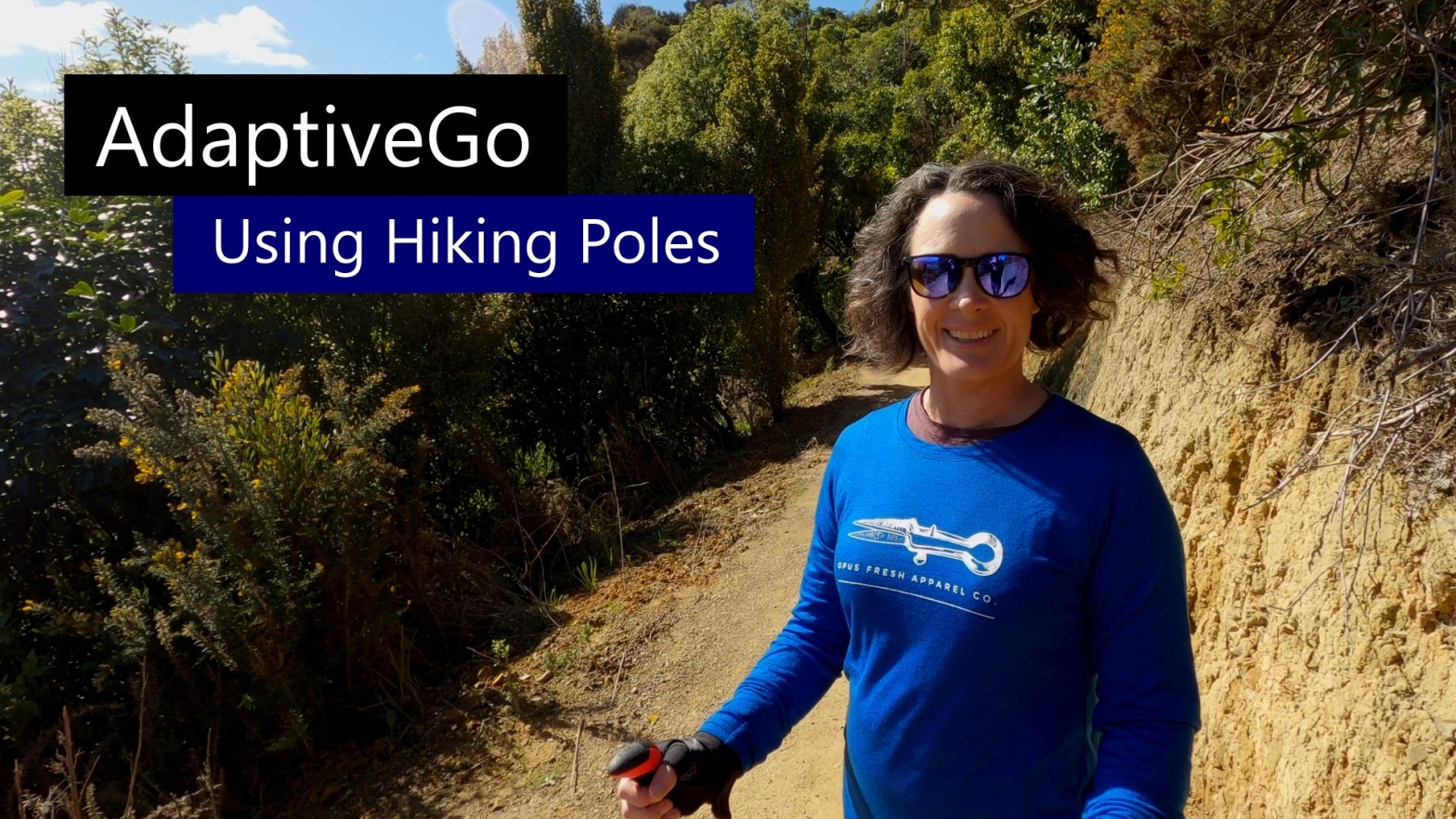
I view adaptive equipment like an athlete. Adaptive equipment will enable me to live life the way I want to. I don’t have to be “bad enough” to use it. I use it because it enables me to do the things I want to do. Hiking poles make me feel like superman. I can go twice the distance (2x round the block), almost twice as long (24 mins vs 13 mins) and I can walk slightly faster. Hiking poles can help even your gait so that you can walk tall, without limping, and engage your core muscles. I’m a fan of hiking or trekking poles to help me live a more full life. I’ll use whatever tool I can to make me better, faster, and stronger.
For most (but not all chronic health conditions) motion is lotion and walking is a low impact exercise that we can use to keep our bodies moving. Putting weight through our legs helps keep our bones strong (Arthritis NZ, 2018). Walking also helps improve back pain (Gillett, R., Eller, J., Roy, R., and Finley, J., 2020). So, if you’ve been told to move your body, but find it hard to walk, then maybe hiking poles is the answer for you.
Source material:
Arthritis NZ, 2018. Physical Activity. Retrieved 05 December from https://www.arthritis.org.nz/wp-content/uploads/2018/10/5629_art_PhysicalActivity_Flyer_1-0-lores.pdf
Bumgardner, W., (08 April 2020), How to use hiking and trekking poles for stability. VeryWellFit. Retrieved 05 December 2020 from http://www.verywellfit.com/how-to-use-hiking-and-trekking-poles-for-stability-4145313
Gillett, R., Eller, J., Roy, R., and Finley, J., (2020). Take control of Back Pain. Live Yes with Arthritis Podcast, Episode 21. Retrieved 05 December 2020 from https://www.arthritis.org/getmedia/f7987c33-05ff-40e5-bced-79b6fc08116c/Podcast_Show-notes-episode-21.pdf
Hazzard, C., (undated). Do I need trekking poles. HikingGuy. Retrieved 05 December 2020 from https://hikingguy.com/how-to-hike/do-i-need-trekking-poles/
Lourdes (undated), 5 Benefits of Hiking with Poles. Monkey and Mountains Adventure Travel. Retrieved 05 December 2020 from https://monkeysandmountains.com/hiking-poles-benefits
Northumbria University. (03 June 2020). How trekking-poles help hikers maintain muscle function while reducing soreness. ScienceDaily. Retrieved December 5, 2020 from http://www.sciencedaily.com/releases/2010/06/100602121000.htm
Taylor, J., (06 June 2019). Walking Poles – some pros and cons. Taylor-Made Fitness. Retrieved December 5, 2020 from http://www.taylormadefitness.biz/2019/06/06/walking-poles-some-pros-and-cons/
 AdaptiveGo